


Cultural Excursion • Historical Deep Dive
Walking the Zona Colonial: A Vias Baseball Cultural Excursion
Before taking the field in Barahona, every Vias Baseball team steps 500 years back in time. Explore the pirate sieges, Taíno revolts, and colonial architecture that forged the Dominican Republic.
“When American athletes walk through these stone archways, history stops being an abstract chapter in a textbook. They realize they are standing at the ground zero of the entire Western Hemisphere.”
— Brian Straley, Founder of Vias BaseballWhen high school, college, or travel baseball teams trip to the Dominican Republic with Vias Baseball, their primary focus is sweat, service, and competition. They spend days coaching youth players, grinding on dusty fields in Villa Central, and providing gear to underserved athletes across Barahona.
But a complete athletic exchange requires context. To truly understand the fierce pride, resilience, and joy that define Dominican baseball, you have to understand the soil from which it grew.
That journey begins on the western bank of the Ozama River in Santo Domingo’s Zona Colonial (Colonial Zone). Spanning less than one square mile, this UNESCO World Heritage site is the oldest continuously inhabited European settlement in the Americas.
Here is Vias Baseball's expanded, step-by-step walking tour guide—designed to take your team past pirate battlegrounds, royal palaces, and ancient cobblestones in a single afternoon.
1498
Year City Founded
1st
European Settlement
1586
Francis Drake Siege
16
Historic City Blocks
1. Puerta del Conde & The Bastion of Independence
We begin our walking route on the western perimeter at La Puerta del Conde (The Count’s Gate).
Before this site was named after the Count of Peñalba, who defended Santo Domingo against an invading British fleet led by William Penn in 1655, it was the primary western defensive wall guarding the city.
For Dominicans, this gate is sacred ground. On the night of February 27, 1844, founding father Matías Ramón Mella fired his historic trabucazo (blunderbuss shot) here, declaring Dominican independence from Haitian rule and unfurling the first Dominican flag.
Today, the gate stands at the head of Parque Independencia, housing the Altar de la Patria—a white marble mausoleum holding the remains of Juan Pablo Duarte, Francisco del Rosario Sánchez, and Ramón Matías Mella.
2. Calle El Conde: Pedestrian Art & Street Culture
Passing through the gate brings you onto Calle El Conde, a kilometer-long pedestrian avenue running straight to the Ozama River.

Calle El Conde, Santo Domingo's bustling pedestrian avenue filled with street performers, artwork, and cafés.
El Conde offers a vivid slice of modern Dominican city life framed by early 20th-century Art Deco and Spanish colonial architecture. Street vendors line the paving stones selling hand-painted canvases depicting Taíno symbols, rural countryside scenes, and iconic baseball figures.
As you walk east down El Conde, stop by a local colmado for fresh coconut water or fresh Dominican coffee (*cafecito*). It’s the perfect place for visiting athletes to practice their Spanish with local shopkeepers.
3. Parque Colón & The Cathedral's Cannonball
At the eastern end of El Conde, the narrow street opens into Parque Colón, a lively public square shaded by massive mahogany trees and centered around a 19th-century bronze statue of Christopher Columbus.
Dominating the southern edge of the plaza is the Catedral Primada de América (Basílica Menor de Santa María de la Encarnación).
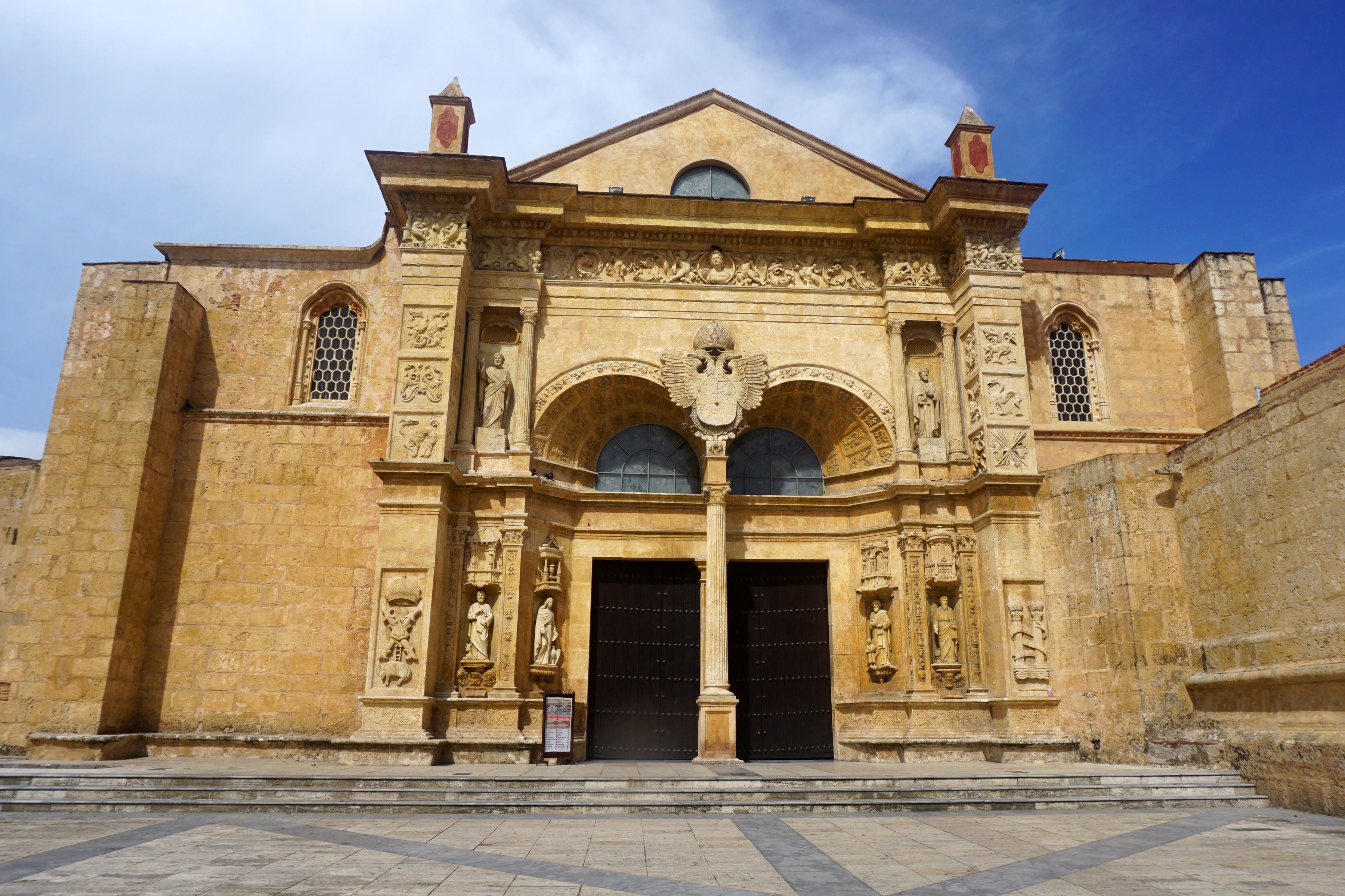
Catedral Primada de América, the first Catholic cathedral built in the Americas (1514–1541).
Commissioned by Pope Julius II in 1504 and built between 1514 and 1541, this coral limestone cathedral represents the first seat of Papal authority in the Western Hemisphere. Its architecture blends late Gothic vaulted ceilings with Plateresque facade embellishments.
The 1586 Siege of Sir Francis Drake
When English privateer Sir Francis Drake captured Santo Domingo in 1586, he looted the city and set up his headquarters inside this cathedral. Before leaving, his artillery crew fired a cannonball into the roof structure. If you look closely at the cathedral’s exterior side portal, you can still see an iron cannonball lodged in the stone wall—a physical reminder of Caribbean naval warfare.
4. Fortaleza Ozama: Columbus in Chains
Heading south from the plaza toward the waterfront brings you to Fortaleza Ozama, situated high on a bluff commanding the mouth of the river.
The main gate of Fortaleza Ozama, constructed between 1502 and 1508.
Constructed under Governor Nicolás de Ovando between 1502 and 1508, Fortaleza Ozama is the oldest military fortress built by Europeans in the Americas. Its thick coral-rock walls were designed to withstand pirate raids and hostile fleets.
At the center of the grounds stands the Torre del Homenaje (Tower of Homage).
This medieval-style keep served as the military command post for Spanish conquistadors. In 1500, following accusations of brutality and mismanagement, Christopher Columbus and his brother Bartolomeo were arrested here under the orders of Royal Commissioner Francisco de Bobadilla before being shipped back to Spain in chains.
5. Calle Las Damas: The Oldest Paved Street
Exiting Fortaleza Ozama puts your feet directly onto Calle Las Damas, paved in 1502 and officially recognized as the oldest paved street in the Americas.
The street earned its name from the noble ladies of María de Toledo’s viceregal court, who strolled along its stone pathway every evening following mass. Walking north along Calle Las Damas passes a series of historic landmarks:
- Panteón Nacional: A 18th-century Jesuit church converted into the national mausoleum, guarded 24/7 by a silent Dominican military guard.
- Museo de las Casas Reales: The original seat of the Real Audiencia (Royal Court of the Indies), serving as the administrative headquarters for Spanish conquest across Mexico, Central America, and South America.
- Casa de Bastidas: A preserved 16th-century mansion featuring an expansive inner courtyard framed by ancient arches.
6. Alcázar de Colón & Plaza España
Calle Las Damas terminates at **Plaza España**, an expansive stone square overlooking the commercial docks of the Ozama River.
Dominating the plaza is the Alcázar de Colón, a fortified palace constructed between 1510 and 1514 for Diego Colón (Christopher Columbus's son) when he served as Governor of the Indies.

Alcázar de Colón, built between 1510 and 1514 without a single nail.
Built out of coral blocks without using a single iron nail, the palace combines late Gothic arches with Italian Renaissance loggias. Today, it operates as a national museum displaying 15th- and 16th-century European tapestries, weapons, and original furniture.
7. The Taíno Legacy: The Revolt of Chief Enriquillo
As our tour wraps up near the riverfront, Vias Baseball coaches take time to share an essential story that links Santo Domingo directly to our home base in Barahona: The Story of Enriquillo.
While the Spanish court governed the Americas from the halls of the Real Audiencia, a young Taíno chief named Enriquillo launched a historic rebellion in 1519. Enriquillo took his people into the rugged Sierra de Bahoruco mountains—just north of modern-day Barahona.
For 14 years, using guerrilla warfare tactics, Enriquillo's fighters successfully held off Spanish forces. In 1533, the Spanish Crown was forced to sign a historic peace treaty granting the Taíno people freedom and land rights.
“When our athletes play in Barahona, they aren't just playing in a remote province—they are playing in the mountains where Chief Enriquillo made history. That same spirit of toughness lives in our players today.”
8. Practical Tips for Visiting Teams & Travelers
If your team or group is planning a walking excursion through the Zona Colonial, keep these practical travel guidelines in mind:
| Excursion Detail | Vias Baseball Recommendation |
|---|---|
| Best Time to Walk | 8:30 AM – 11:30 AM (beat the afternoon heat) or 4:00 PM – 7:30 PM |
| Footwear & Attire | Sturdy athletic sneakers for uneven cobblestones; shoulders/knees covered for Cathedral entry |
| Hydration & Snacks | Carry bottled water; stop for fresh fruit along Calle Isabel La Católica |
| Safety & Guidance | The Zona Colonial is heavily patrolled by POLITUR (Tourism Police) and safe for daytime walking groups |
Combine Sports & Cultural Service in the DR
Vias Baseball organizes custom team trips, high school service excursions, and athletic exchanges that combine real baseball competition in Barahona with immersive cultural tours across Santo Domingo.